
Grade percentage, a cornerstone of academic evaluation, is more than just a number; it’s a reflection of a student’s performance, a tool for educators, and a key driver of motivation. From elementary schools to universities, the conversion of raw scores into percentages provides a standardized metric for assessing knowledge and skills. This comprehensive exploration delves into the intricacies of grade percentage calculations, their practical applications, and their profound impact on students and the educational landscape.
We’ll unpack the mathematical operations underpinning these calculations, explore how they are applied across various scoring systems, and examine the critical role of weighting assignments. Furthermore, we’ll navigate the practical uses of grade percentages in educational settings, comparing grading scales, and analyzing their influence on academic standing. The journey continues with a deep dive into student motivation, the role of self-assessment, and the use of digital tools, culminating in a discussion of common challenges and misconceptions related to grade percentages. This examination aims to provide a complete understanding of how grade percentages shape the educational experience.
Understanding the Fundamental Concepts of Grade Percentage Calculations
Calculating grade percentages is a fundamental skill in education, providing a standardized way to assess student performance across different assessments. This process transforms raw scores into a percentage, making it easier to compare and understand a student’s achievement relative to the total possible points. Accurate percentage calculations are crucial for evaluating progress, assigning final grades, and identifying areas where students may need additional support. This section will delve into the basic mathematical operations involved, explore how to convert raw scores into percentages, and explain the significance of weighting different assessments.
Basic Mathematical Operations in Grade Percentage Calculations
Grade percentage calculations primarily rely on basic arithmetic operations. Understanding these operations is essential for grasping the underlying principles. The core operations involved are addition, subtraction, multiplication, and division. These are used in different combinations depending on the complexity of the assessment and the scoring system employed. The foundational principle involves determining the proportion of points earned out of the total possible points.
The core concept is to determine the ratio of the earned score to the total possible score and then express that ratio as a percentage. This conversion provides a clear, easily understood representation of a student’s performance. Consider the following breakdown of the essential operations:
- Addition: Used to calculate the total possible points on an assessment or the total points earned by a student across multiple components. For example, if a test has multiple sections, the points allocated to each section are added to determine the total points possible.
- Subtraction: Used less frequently in basic percentage calculations but may be involved when calculating the difference between a student’s score and the maximum possible score to determine the points missed.
- Multiplication: Crucial for converting the ratio of earned points to total points into a percentage. The ratio is multiplied by 100 to express it as a percentage. For example, if a student scores 8 out of 10, the ratio (8/10) is multiplied by 100 to get 80%.
- Division: The primary operation for calculating the ratio of earned points to total points. The earned points are divided by the total possible points. The result of this division is then multiplied by 100 to obtain the percentage.
These operations, when combined, allow educators to accurately and consistently evaluate student performance, providing valuable feedback and facilitating a fair assessment process.
Converting Raw Scores into Percentages
Converting raw scores into percentages is a fundamental aspect of grading. This process involves expressing a student’s score as a proportion of the total possible points, which is then converted to a percentage. The formula used remains consistent across different assessment types, though the application may vary slightly depending on the scoring system. Here’s a detailed walkthrough with examples and a formatted HTML table to illustrate the process:
The core formula for converting a raw score to a percentage is as follows:
Percentage = (Earned Score / Total Possible Score) * 100
Let’s consider some examples for both tests and assignments:
- Test Example: A student takes a test with a total of 50 points and scores 42 points. The calculation would be: (42 / 50) * 100 = 84%.
- Assignment Example: A student submits an assignment worth 20 points and receives a score of 17 points. The calculation would be: (17 / 20) * 100 = 85%.
Different scoring systems, such as those that involve partial credit, don’t change the fundamental approach, just the numbers used in the calculation. If a student receives partial credit on a question, the earned score reflects the points awarded for that specific answer.
The following table provides a clear overview of the process:
| Assessment Type | Total Possible Points | Student’s Score | Percentage Calculation |
|---|---|---|---|
| Test | 50 | 42 | (42 / 50) * 100 = 84% |
| Assignment | 20 | 17 | (17 / 20) * 100 = 85% |
| Quiz | 10 | 8 | (8 / 10) * 100 = 80% |
| Project | 100 | 90 | (90 / 100) * 100 = 90% |
Calculating Weighted Grade Percentages
Weighting different assignments or assessments is a crucial element in creating a comprehensive grading system. Weighting allows educators to assign different levels of importance to various components of a course, reflecting the relative contribution of each component to the overall learning objectives. This approach ensures that more significant assessments, such as final exams, carry more weight in the final grade compared to smaller assignments, like quizzes. The rationale behind weighting is to provide a fair and accurate reflection of a student’s overall understanding and mastery of the course material.
To calculate weighted grade percentages, each assessment’s percentage score is multiplied by its assigned weight, and the results are then summed. The weights are usually expressed as percentages, and the sum of all weights should equal 100%. Here’s a step-by-step process:
- Determine the weight of each assessment: For example, a final exam might be worth 30%, midterm exams 20% each, assignments 20%, and participation 10%.
- Calculate the percentage score for each assessment: This involves using the formula described above (Earned Score / Total Possible Score * 100).
- Multiply each assessment’s percentage score by its weight: For example, if a student scores 85% on the final exam (30% weight), the weighted score is 85 * 0.30 = 25.5.
- Sum the weighted scores: Add up all the weighted scores to determine the final grade percentage.
For example, a student’s performance across a course might look like this:
- Final Exam: 90% (30% weight) = 27
- Midterm 1: 80% (20% weight) = 16
- Midterm 2: 75% (20% weight) = 15
- Assignments: 95% (20% weight) = 19
- Participation: 100% (10% weight) = 10
The student’s final grade percentage would be 27 + 16 + 15 + 19 + 10 = 87%. This demonstrates how weighting ensures that the final exam, as a significant assessment, contributes substantially to the overall grade.
Practical Applications of Grade Percentage in Educational Settings
Grade percentages are the bedrock of student evaluation, providing a standardized and quantifiable method for assessing academic performance. Their widespread use facilitates consistent comparisons across subjects, institutions, and even different periods. Understanding how these percentages are applied in practice is crucial for both educators and students.
Utilizing Grade Percentages for Assessment
Teachers and other educational professionals leverage grade percentages in diverse ways to evaluate student performance, adapting their approaches based on the subject matter, educational level, and institutional policies. These methods provide a clear picture of student understanding and progress.
- Assessing Individual Assignments: The most basic application involves assigning percentages to individual assignments like quizzes, homework, and essays. For example, a teacher might grade a 10-question quiz where each question is worth 10 points. A student answering 7 questions correctly would receive a score of 70%, calculated as (7 correct answers / 10 total questions) * 100. Similarly, an essay graded out of 100 points might receive a percentage score based on criteria such as content, organization, and grammar.
- Weighting Different Assessment Components: Teachers often weight different assessment components to reflect their relative importance. For instance, a final exam might be worth 40% of the final grade, while quizzes contribute 20%, homework 20%, and class participation 20%. This weighting system allows educators to prioritize certain skills or areas of knowledge.
- Subject-Specific Applications: The application of grade percentages can vary significantly across different subjects. In mathematics, percentages are frequently used to assess problem-solving skills and accuracy in calculations. In science, percentages might be applied to lab reports, experiments, and theoretical concepts. In humanities, percentages evaluate essays, presentations, and participation in class discussions. For example, in a history class, a research paper might be graded on content (50%), analysis (30%), and writing quality (20%).
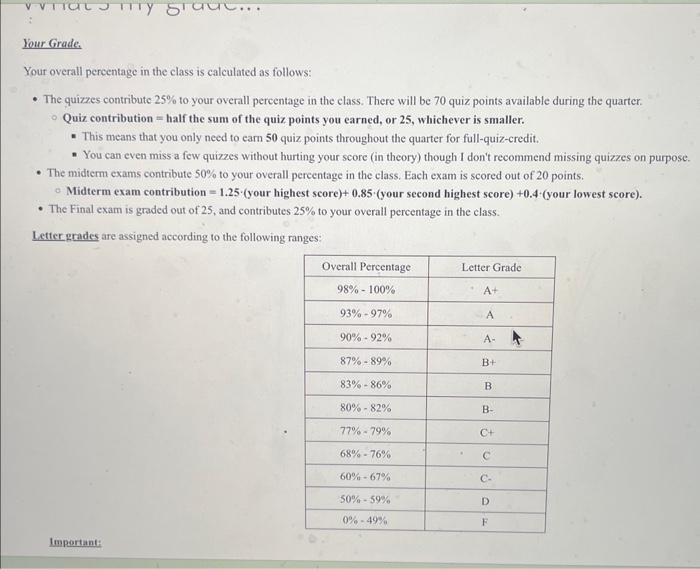
- Variations in Grading Policies: Grading policies can vary substantially between schools and even within departments of the same school. Some institutions may use a curve, adjusting grades based on the overall performance of the class. Others may have strict cutoffs for letter grades (e.g., 90-100% = A, 80-89% = B). Some schools use a points-based system where assignments are assigned points, and the total points earned determine the final grade percentage.
Comparing and Contrasting Grading Scales
Different grading scales offer distinct advantages and disadvantages, impacting how student performance is perceived and assessed. The choice of scale often depends on the educational philosophy of the institution and the specific goals of the course.
Grading Scales
Percentage Grading: This is a numerical system where grades are expressed as percentages.
Letter Grading: This system uses letters (A, B, C, D, F) to represent ranges of percentages.
Pass/Fail Grading: This is a binary system indicating whether a student has met the required standard.
Narrative Assessment: This provides descriptive feedback on student performance.
- Percentage Grading: This is the most granular grading system, allowing for precise distinctions between student performance. The advantages include its straightforward nature and ease of calculation. However, the disadvantages include the potential for grade inflation and the subjective nature of assigning points to individual assignments. For example, a student scoring 87% might be perceived differently from a student scoring 88%, even though the difference in actual knowledge or skill might be minimal.
- Letter Grading: This is a widely used system that simplifies the interpretation of grades. Its advantages include ease of understanding and comparison across different courses and institutions. However, the disadvantages are the loss of fine-grained distinctions between student performances within a grade range. For instance, two students both earning a B (80-89%) may have significantly different percentage scores (e.g., 81% and 89%), but their letter grades are the same.
Letter grading can also vary; some institutions include pluses and minuses (e.g., A+, A, A-), while others do not.
- Pass/Fail Grading: This system is typically used for courses that are not central to a student’s major or for certain types of assessments, such as internships or research projects. The advantage is its focus on mastery rather than ranking. However, the disadvantage is that it provides limited information about a student’s performance level.
This system is less common for core academic courses.
- Narrative Assessment: This method provides detailed, descriptive feedback on a student’s strengths and weaknesses. The advantages include the personalized nature of the feedback and the opportunity for in-depth evaluation. However, the disadvantages are the time-consuming nature of providing such feedback and the lack of a standardized metric for comparison.
Narrative assessments are often used in early childhood education or for specific projects.
Determining Final Grades
The final grade is a culmination of all the assessments throughout a semester or term, providing a comprehensive evaluation of a student’s performance. The process involves calculating averages and applying weighting schemes.
- Calculating Semester or Term Averages: Final grades are usually determined by calculating a weighted average of all graded assignments. This process involves multiplying each assignment’s percentage score by its corresponding weight and then summing the results. For example, if a student has a 90% on a midterm exam (worth 25%), an 85% on a final project (worth 35%), and an 80% average on quizzes and homework (worth 40%), their final grade would be calculated as: (0.90 * 0.25) + (0.85 * 0.35) + (0.80 * 0.40) = 0.225 + 0.2975 + 0.32 = 0.8425 or 84.25%.
- Influencing Academic Standing: Final grades are crucial in determining a student’s academic standing, which includes their GPA (Grade Point Average), class rank, and eligibility for scholarships, honors programs, and graduation. A high GPA opens doors to various opportunities, such as advanced studies, internships, and employment. A low GPA can lead to academic probation or dismissal. The cutoffs for these standings vary among institutions.
For instance, a GPA of 3.5 or higher might be required for Dean’s List recognition, while a GPA below 2.0 could result in academic probation.
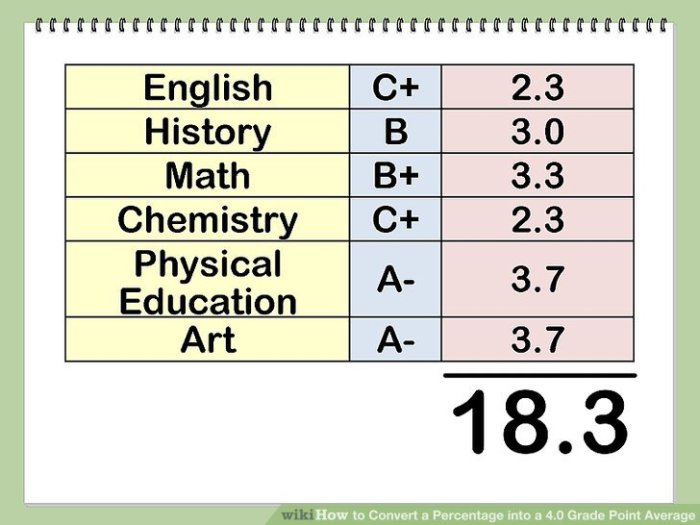
- Impact of Grade Percentages: The final grade percentage directly impacts a student’s GPA. The GPA is a numerical representation of a student’s overall academic performance, often used for comparisons across different courses and institutions.
A student with a higher percentage score in a course will typically have a higher grade point, which will increase their GPA.
The Role of Grade Percentage in Student Motivation and Achievement
Grade percentages are a powerful tool in education, acting as both a measure of performance and a motivator for students. They offer a clear, quantifiable representation of academic progress, allowing students to understand their strengths and weaknesses and to chart a course for improvement. This understanding can significantly influence a student’s drive to succeed.
Tracking Progress and Identifying Areas for Improvement
Students can leverage grade percentages as a dynamic tool to monitor their academic journey. By regularly reviewing their grades, they gain insights into their performance across various subjects and assignments. This self-assessment process is crucial for informed decision-making.
A student can track their progress by comparing their grades over time, identifying trends, and pinpointing areas where they excel or struggle. For example, a student consistently scoring high in math quizzes but struggling with essay writing in English can immediately recognize a need for improvement in their writing skills. They can then take proactive steps to address this, such as seeking help from a tutor, attending writing workshops, or practicing essay writing with feedback from their teacher.
To effectively self-assess and set goals, students can employ several strategies:
* Maintain a Grade Tracker: Use a spreadsheet or a dedicated notebook to record all grades, including assignment types (quizzes, tests, homework).
* Analyze Grade Trends: Look for patterns. Are grades consistently improving, declining, or fluctuating?
* Identify Weak Areas: Focus on subjects or assignments where grades are consistently lower.
* Set Specific, Measurable, Achievable, Relevant, and Time-bound (SMART) Goals: Instead of a vague goal like “improve my math grade,” set a SMART goal such as “increase my quiz scores in Chapter 3 by 10% within the next two weeks by completing all practice problems.”
* Regularly Review and Adjust Goals: Monitor progress and adjust goals as needed.
Impact of Grade Percentages on Student Motivation
Grade percentages can exert a significant influence on student motivation, both positively and negatively. A high grade can be a powerful source of intrinsic motivation, boosting self-esteem and encouraging further effort. Conversely, consistently low grades can lead to demotivation, anxiety, and a sense of helplessness.
Positive influences include the feeling of accomplishment when achieving a high grade, which reinforces positive study habits. The visibility of progress provides a sense of control and encourages continuous effort.
Negative influences include the pressure to perform, which can lead to test anxiety and a fear of failure. Students may feel discouraged if they perceive their efforts as not yielding desired results, potentially leading to disengagement.
Scenario with Potential Challenges:
Consider a student named Alex, who consistently receives low grades in science. Alex’s initial reaction is frustration and a belief that they are “not good at science.” This demotivation leads to decreased effort, procrastination, and a further decline in grades. Eventually, Alex stops attending science classes regularly and gives up on the subject altogether. This scenario illustrates how negative experiences with grade percentages can create a cycle of demotivation and academic decline. To mitigate this, Alex needs to change their mindset, create SMART goals, and actively seek help.
Tips for Effectively Managing Grades
Effective grade management is a key factor in academic success. It requires a combination of good study habits, time management skills, and a willingness to seek support when needed.
* Time Management: Create a realistic study schedule and stick to it. Prioritize tasks based on deadlines and importance. Use tools like calendars and to-do lists to stay organized.
* Effective Study Habits: Find a study environment that minimizes distractions. Use active learning techniques like summarizing, teaching the material to someone else, and practicing past papers. Vary study methods to keep the brain engaged.
* Seek Help When Needed: Don’t hesitate to ask teachers, tutors, or classmates for help. Attend office hours, form study groups, and utilize available resources.
* Stay Organized: Keep track of assignments, deadlines, and grades. Use a planner or digital calendar to manage your workload. Maintain organized notes and study materials.
* Understand Grading Criteria: Familiarize yourself with how your grades are calculated. Understand the weight of different assignments and tests. Ask your teacher for clarification if needed.
* Prioritize Well-being: Get enough sleep, eat nutritious meals, and exercise regularly. Manage stress and take breaks when needed. A healthy mind and body are essential for academic success.
Tools and Technologies for Managing Grade Percentages
Managing and understanding grade percentages is significantly streamlined through the use of various tools and technologies. These resources range from specialized software designed for educational institutions to widely accessible spreadsheet applications. The choice of tool depends on the scale of the operation, the desired level of detail, and the specific needs of the educator or institution.
Software Applications and Online Tools for Calculating and Tracking Grade Percentages
Several software applications and online tools are specifically designed to assist educators in calculating and tracking grade percentages. These tools offer features that go beyond basic calculations, including gradebook management, student progress tracking, and reporting capabilities.
- Learning Management Systems (LMS): Platforms like Canvas, Moodle, and Blackboard are commonly used by educational institutions. They integrate grade calculation features directly into their systems. These systems allow educators to create assignments, quizzes, and other assessments, and then automatically calculate grade percentages based on student performance. They also offer features like student progress dashboards, communication tools, and integration with other educational resources. These systems are especially beneficial for larger institutions or those with a need for robust data management.
- Specialized Gradebook Software: Applications like GradeCam and PowerSchool provide comprehensive gradebook management functionalities. These programs often offer features such as customizable grading scales, weighted averages, and the ability to import and export data. They may also provide advanced reporting options, allowing educators to analyze student performance and identify areas for improvement. Some software offers automated parent and student portals, enhancing communication and transparency.
- Online Grade Calculators: Numerous free online grade calculators are available. These tools are typically simpler than dedicated software, offering basic percentage calculations based on entered scores and total points. While convenient for quick calculations, they often lack advanced features like data storage or reporting capabilities.
Using Spreadsheet Software for Calculating and Visualizing Grade Percentages
Spreadsheet software like Microsoft Excel and Google Sheets provides a versatile platform for calculating and visualizing grade percentages. These programs offer a user-friendly interface and a wide range of functions that can be adapted to various grading scenarios.
- Creating a Gradebook: Start by creating a spreadsheet with columns for student names, assignments, and total points possible. For each assignment, enter the student’s score in the corresponding cell.
- Calculating Percentages: Use a formula to calculate the percentage for each assignment. For example, if a student scores 85 out of 100 on an assignment, the formula would be:
=(StudentScore/TotalPoints)*100
This formula, entered in a new column, automatically calculates the percentage for each student and each assignment.
- Calculating Weighted Averages: To calculate a weighted average, assign a weight to each assignment. Multiply the percentage for each assignment by its weight, and then sum the results. For example, if a quiz is worth 20% and a test is worth 80%, the weighted average would reflect this distribution.
- Visualizing Data: Use charts and graphs to visualize grade percentages. For example, a bar chart can show the distribution of grades across a class, while a pie chart can represent the contribution of each assignment to the final grade. These visualizations provide a clear overview of student performance and help identify trends.
Benefits and Drawbacks of Digital Tools Versus Traditional Methods
Digital tools offer significant advantages over traditional methods, but they also have some drawbacks. Understanding these trade-offs is crucial for choosing the right approach for a particular context.
- Digital Tools Benefits: Digital tools, such as spreadsheet software and dedicated gradebook applications, offer increased efficiency and accuracy. They automate calculations, reduce the risk of human error, and provide features for data storage and analysis. They also facilitate easier communication with students and parents through online portals and automated reports. The ability to visualize data through charts and graphs is a significant advantage, providing educators with a clearer understanding of student performance. For instance, a teacher can instantly update a student’s grade in a digital gradebook, and the student and their parents can immediately see the change, promoting transparency and timely feedback.
- Digital Tools Drawbacks: Digital tools require access to technology and a certain level of digital literacy. Technical issues, such as software glitches or internet outages, can disrupt the grading process. Privacy and security concerns are also present, as student data is stored electronically. Furthermore, relying too heavily on digital tools can sometimes lead to a disconnect from the personal touch of traditional methods.
- Traditional Methods Benefits: Traditional methods, such as manual calculations and paper-based gradebooks, require no reliance on technology. They can be useful in situations where access to technology is limited or unreliable. They may also be perceived as more secure from a data privacy standpoint.
- Traditional Methods Drawbacks: Traditional methods are time-consuming and prone to errors. Calculations are often performed manually, increasing the risk of mistakes. Data storage and analysis are more difficult, and communication with students and parents is often less efficient. The lack of data visualization tools makes it harder to identify trends and patterns in student performance. An example of a traditional drawback would be the time required to manually calculate and record grades for a large class, which can be significantly reduced with digital tools.
Common Challenges and Misconceptions Related to Grade Percentages
Grade percentages, while seemingly straightforward, are often misunderstood, leading to skewed perceptions of academic performance and potentially hindering student motivation. This section delves into the common pitfalls associated with grade percentage interpretation, exploring the underlying causes and offering practical solutions to promote a more accurate and beneficial understanding. The aim is to clarify these complexities, empowering both students and educators to navigate the grading system effectively.
Common Misunderstandings About Grade Percentages
Several common misconceptions cloud students’ understanding of grade percentages, impacting their self-assessment and academic strategy. These misunderstandings can lead to unnecessary anxiety, demotivation, or a false sense of security.
- Percentage as Absolute Knowledge: Students sometimes interpret a percentage as a direct measure of what they know, rather than a reflection of their performance on a specific assessment. For instance, a student achieving 80% might believe they possess 80% of the knowledge related to the subject, which is not always accurate. Their score could be higher or lower depending on the difficulty and focus of the test.
- Ignoring the Weighting of Assessments: A common error is failing to account for the varying weights assigned to different assignments or assessments. A student might be overly concerned about a single low score on a minor quiz, neglecting the significant impact of a higher score on a major project.
- Focusing Solely on the Number: Students may fixate on the numerical value of their grade, without considering the feedback provided or the areas where they can improve. An 85% might be celebrated without analyzing which specific concepts were missed, thus hindering the learning process.
- Equating Percentages Across Different Courses: A grade of 90% in one subject does not necessarily equate to the same level of mastery as a 90% in another subject. Course difficulty, grading standards, and the nature of the material can significantly vary.
- Assuming a Linear Relationship Between Effort and Grade: While effort is crucial, students may mistakenly believe that increased effort always translates directly into a higher grade percentage. Other factors, such as understanding the material, test-taking skills, and effective study strategies, also play a vital role.
Strategies for Addressing Misconceptions
Clear and effective communication is essential to combat these misunderstandings. Educators can employ several strategies to foster a more informed and accurate understanding of grade percentages.
- Transparent Grading Rubrics: Provide detailed rubrics for all assignments and assessments. These rubrics should clearly Artikel the criteria for evaluation, the weight assigned to each criterion, and the corresponding percentage ranges. This allows students to understand exactly how their work is being evaluated.
- Regular Feedback and Communication: Offer frequent and constructive feedback on student work. This feedback should go beyond simply providing a numerical grade and should include specific comments on strengths, weaknesses, and areas for improvement. Use this feedback to guide students.
- Explanation of Assessment Weighting: Explicitly explain the weighting system used in the course, including the percentage contribution of each assignment and assessment to the final grade. Provide examples of how these weights influence the overall grade.
- Encouraging Self-Reflection: Promote self-reflection by asking students to analyze their performance, identify areas of difficulty, and develop strategies for improvement. Guide them to focus on the learning process, not just the final number.
- Comparative Analysis with Caution: When comparing performance across different courses, emphasize the variations in difficulty, assessment methods, and grading standards. Discourage direct comparisons without considering these contextual factors.
- Emphasizing the Learning Process: Shift the focus from the grade percentage to the learning process. Encourage students to see grades as a measure of progress, a tool for improvement, and an opportunity for growth, rather than a definitive judgment of their abilities.
Potential Biases Influencing Grade Percentages and Mitigation Strategies
Grade percentages can be influenced by various biases, potentially leading to unfair or inaccurate assessments. Recognizing and mitigating these biases is crucial for ensuring fairness and promoting a level playing field for all students.
- Teacher Subjectivity: Teacher subjectivity in grading can introduce bias. Personal opinions, implicit biases, or a lack of standardized grading practices can affect the evaluation of student work.
- Assessment Design: The design of assessments can also contribute to bias. Assessments that are not aligned with learning objectives, or that favor certain learning styles or cultural backgrounds, may disadvantage some students.
- Halo Effect: Teachers may be influenced by the “halo effect,” where their overall impression of a student (e.g., a student’s behavior or previous performance) impacts their grading of specific assignments.
- Unconscious Bias: Teachers may have unconscious biases based on students’ race, gender, socioeconomic status, or other demographic factors, which can influence their grading.
To mitigate these biases, several strategies can be implemented:
- Standardized Rubrics and Criteria: Use clear, detailed rubrics that specify the criteria for evaluation and the corresponding percentage ranges.
- Blind Grading: Implement blind grading, where teachers do not know the identity of the student when evaluating their work.
- Multiple Assessors: Involve multiple assessors in grading, especially for major assignments. This allows for cross-validation and reduces the impact of individual biases.
- Assessment Alignment: Ensure that assessments are aligned with learning objectives and course content. Use a variety of assessment methods to accommodate different learning styles.
- Bias Training: Provide teachers with training on recognizing and mitigating unconscious biases in grading.
- Regular Review of Grading Practices: Conduct regular reviews of grading practices to identify and address any potential biases.
Closing Notes
In conclusion, the effective use of grade percentages is crucial for both students and educators. Understanding the calculations, applying them thoughtfully, and recognizing their impact on motivation can significantly enhance the learning process. From tracking progress and setting goals to leveraging digital tools and addressing misconceptions, the mastery of grade percentages empowers students to take control of their academic journey and allows educators to provide clear, consistent feedback. Ultimately, a thorough grasp of grade percentages fosters a more informed, engaged, and successful educational experience.
